

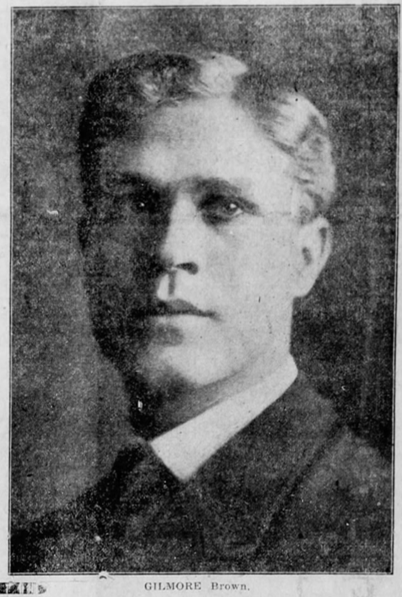
Gilmor Brown’s days absorbing knowledge and culture from Chicago’s literati at glamorous teas helped get him his job with Ben Greet’s company and subsequent employment, but they could not have prepared him for the road. His future collaborator, Charlie Edwards, avoided professional acting or lecturing for this very reason; the road could be brutal, and after his affluent upbringing, Charlie could not keep up with the pace. Gilmor Brown was more suited for the hardship. After two worthwhile seasons with Ben Greet, where he learned much and acted alongside up-and-coming stars like Sybil Thorndike, Gilmor found a fresh and intriguing opportunity with Canadian Actor Harold Nelson and his Shakespearean Company.[1]
Like Gilmor’s mentor, Florence James Adams, Nelson’s dramatic philosophies also could be traced to the broad, grandiloquent style of the last century and the indefatigable Steele MacKaye.Despite his reliance on these old-fashioned fundamentals, Nelson had his own mission. He sought to create Shakespeare for Canada’s rural communities, thus supporting the country’s theatrical culture as a whole; however, this was no easy task. With large geographic swaths of land to traverse and little appropriate infrastructure, the brutal Canadian winter took its toll on the impresario and his actors. Still, Nelson was proud to be the first actor to “introduce Shakespearean plays in the west” of Canada.[2] Gilmor had joined the well-known actor on his sixth tour through Manitoba; since he was established, like Greet, it would have been safe to assume the experience would be highly organized and rewarding. However, the motivated and ambitious Nelson was no match for Mother Nature.
Early 1907 was especially glacial in Canada. Gilmor later recalled that the temperatures were “sixty-below zero,” which appears to be only moderate hyperbole. Snow frequently imprisoned the company in one town, making it difficult to bring in the requisite funds. The heating in hotels and theatres could not keep up with the arctic air, just as snow blockades displaced the actor’s lifeblood, the ticket-buying public.
When actors did arrive safely in town, as one of the most junior company members, Gilmor was required to secure borrowed furniture for props. The outcome of his equipment quest became irrelevant, as the actors became ill, and so did their leader. Eventually, the enervated thespians found themselves beyond snowbound; they were broke and stranded. The tour was over. Now, the convalescent Nelson retreated to Winnipeg for the summer, hoping that “next winter will give us surcease from the such cold sorrow.”[3]
While Nelson could sustain the financial loss and recover, the members of his company were not so fortunate. One of his lieutenants, William Yule, reorganized the reduced and anxious company for a tour under his leadership.[4] With little choice, Gilmor signed on. However, after a brief provincial stint, this company also failed. Completely broke, they were offered transport by a benevolent freight train crew. The humbling ride amid the cargo took the disconsolate Gilmor to Winnipeg, where he wired his parents for help and received just enough money to slink home to Colorado. Unceremoniously, the Canadian trail had come to an end, and he was unemployed.
Penniless, but not entirely defeated, Gilmor Brown put his head down and went back to work in his hometown. Months of unresplendent toil ticked by before he found a prospect. Gilmor secured an audition for a regionally known second-tier Shakespearean actress and her company. Her name was May Stewart. She graduated from Fulton & Trueblood’s Kansas City School of Oratory in the 1880s, along with a man named Preston Dillenbeck (more to come on both of these new characters next week). Gilmor was Kansas-bound.
Also, more to come on Gilmor’s story in a couple of weeks! His theatrical work would become incredibly consequential, but would be rarely acknowledged. Gilmor’s educational work would go on to directly impact television and film luminaries, like Rue McClanahan, Leonard Nimoy, Dustin Hoffman, Sally Struthers, and myriad others.
Sources
[i] Shoup, 26-27. The Winnipeg Tribune, 20 Mar 1907, p. 11;
[ii] Nelson learned from Franklin Sargeant, Steele MacKaye’s onetime student and later collaborator. Arrell, D. (1980). Harold Nelson: The Early Years (c. 1865-1905). Theatre Research in Canada / Recherches théâtrales Au Canada, 1(2). Retrieved from https://journals.lib.unb.ca/index.php/TRIC/article/view/7528
[iii] The Saturday News, Edmonton, Alberta; 13 Apr 1907, p. 3; “Winnipeg as a Theatre Town” The Winnipeg Tribune 22 Mar 1907, Winnipeg, MB, p. 5
[iv] 13 May 1907, The Leader-Post, Shoup 26

 Community Arts Uncovered
Leave a comment