

100 years ago today, a prolific and remarkable era in history ended in Kinsley, Kansas. I’m returning to Community Arts Uncovered to commemorate this historic anniversary and reignite the mission of examining lost theatrical stories.
On June 1, 1926, one of Kinsley’s most well-known native sons, Charles Rufus Edwards, passed away; he was only forty-five years old. In his short life, he was instrumental in a local movement that transformed Kinsley into a regional capital for arts and cultural events.
A local newspaper editor, a poet, and a lifelong promoter of all-things-Kinsley, Charlie, as he was known, was born in Kinsley on December 6, 1880, to two prominent locals. His father was R Eugene Edwards, a cattleman, banker, brother to the county’s namesake, and real estate mogul, and his mother was Elizabeth “Lizzie” Edwards. Lizzie was the scion of an influential family that “built Philadelphia” (see Vitiello’s Engineering Philadelphia: The Sellers Family and the Industrial Metropolis) and the daughter of a character that Mark Twain used to epitomize the Gilded Age, Colonel Charles C Sellers, Kinsley’s onetime mayor. Charlie was born to do great things; his father’s expectations could not have been higher. This was all for the best, as he would achieve feats far beyond Eugene’s expectations, but yet they would not be in business. Today, my research into Charlie’s life showcases his artistic contributions to many communities; this project does not immortalize his father’s wealth.

While Eugene and Lizzie would have another child, Marion Edwards, who would go on to marry a powerful congressman and Wilson administration official, Jouett Shouse, Charlie was the male heir; the family name and legacy were his to further. He spent his life wrestling with these expectations.
With a real estate and banking empire to inherit, Charlie only wanted to perform in plays. Ever since he was three years old, in his first theatrical performance, all he could think of was the stage. Eugene, a staunch embodiment of Gilded Age monopolies, thought his son’s preoccupation with literature and drama would be a phase that he could grow out of, but Charlie never did.
As the years passed by, and instead of running the local general store owned by his father, Edwards and Noble, Charlie started local clubs and organizations for cultural activities. He never married, and his family knew the truth; Charlie was a gay man. The cultural expectations of the early twentieth century made this reality very difficult for him and his family, and he spent most, but not all, of his time hiding and pretending (I will eventually share how some of his early writings challenge heteronormative beliefs). On the stage, however, locally and beyond, he found his solace. There, he created incredible performances that captivated thousands of audience members and involved hundreds of locals directly in the performance.
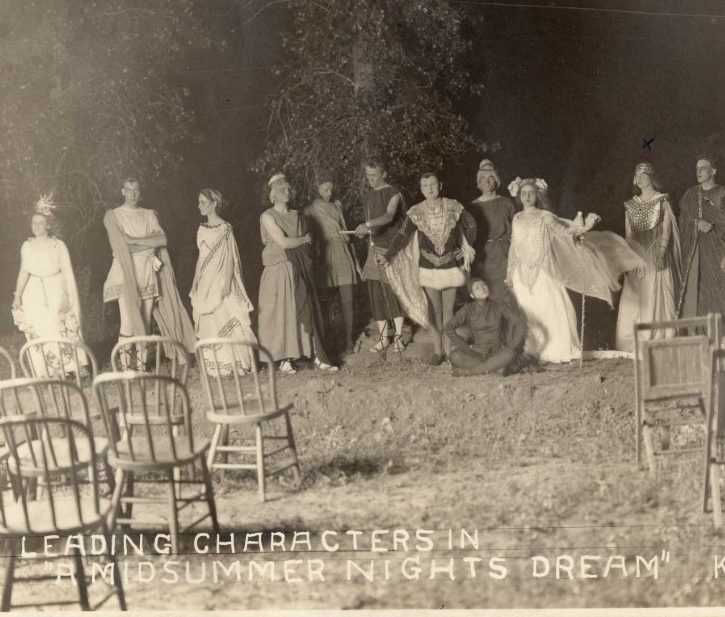
Charlie’s opus magnum was his 1912 Shakespeare festival, which involved one hundred local amateur performers and a touring professional actor, Gilmor Brown. This magical performance was remembered for decades after, and caught my attention well over a century after it occurred as I researched American Shakespeare performances in the archives of the Huntington Library in Southern California. Charlie’s story was there waiting to be uncovered because of his acquaintance with the previously mentioned professional touring actor, Gilmor Brown. After learning with Charlie in Kansas, in a few years, he would go on to found the Pasadena Community Playhouse, the State Theatre of California, and an incubator for generations of Hollywood stars.
The magic of the Kinsley Shakespeare festival, which ran for only 5 years in the 1910s, is covered more in depth in my recent History Press book co-authored with Joan Weaver, The Hidden History of Kinsley. I also published this discovery in a peer-reviewed journal in Shakespeare studies, Shakespeare Bulletin, in the 2021 essay: “Grassroots Shakespeare.” In this publication, I argued that Kinsley’s Shakespeare festival, founded by Charlie, was one of the earliest modern Shakespeare festivals in the country, created long before still well-known groups like the Oregon Shakespeare Festival or the New York Shakespeare Festival (now The Public Theatre).
Charlie and his team of locals from Kinsley made this consequential and historic work happen. He established the first outdoor theatre in Kansas within the city’s limits, the Meadowbrook Theatre; though, it would see only two performances before the beginning of the First World War. By the 1920s, the Meadowbrook Theatre was a place for meetings and picnics. By the 1930s, in the midst of the Depression and the Dust Bowl, the theatre was gone.
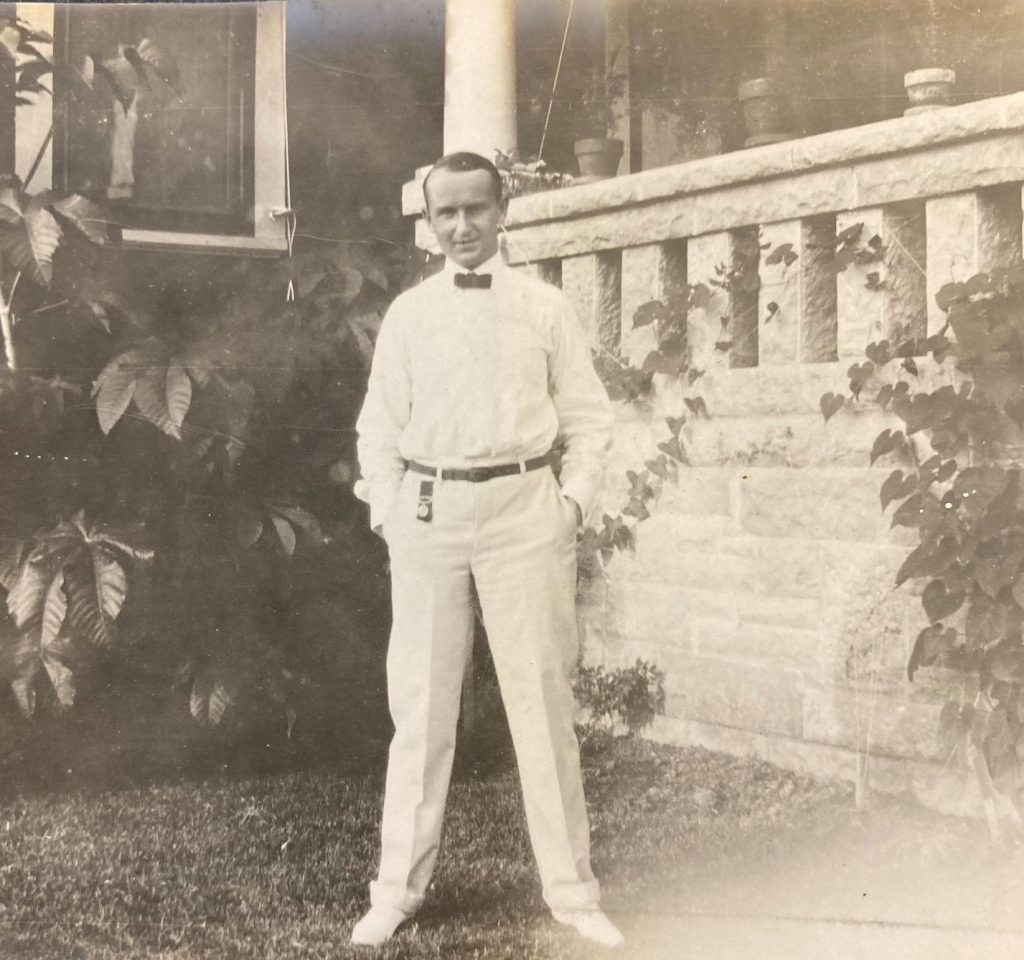
Still, Charlie Edwards led many influential productions in his small hometown. His final 1916 performance at the Meadowbrook of Shakespeare’s Twelfth Night may be one of, if not the, largest performance of the play ever in its over four centuries of history. It featured 300 local performances, 20% of Kinsley’s population! It was civic drama unrivaled anywhere else in the United States, just by the sheer level of community involvement. While he had endless pride in his hometown, Charlie also performed throughout the country. He was part of consequential productions in New York City, including Percy MacKaye’s Caliban and the Washington Square Players’ 1915-1916 season. He led significant companies involved in the nationwide Little Theatre Movement, including the Harlequin Players in Kansas City and the Tulsa Little Theatre in Oklahoma.
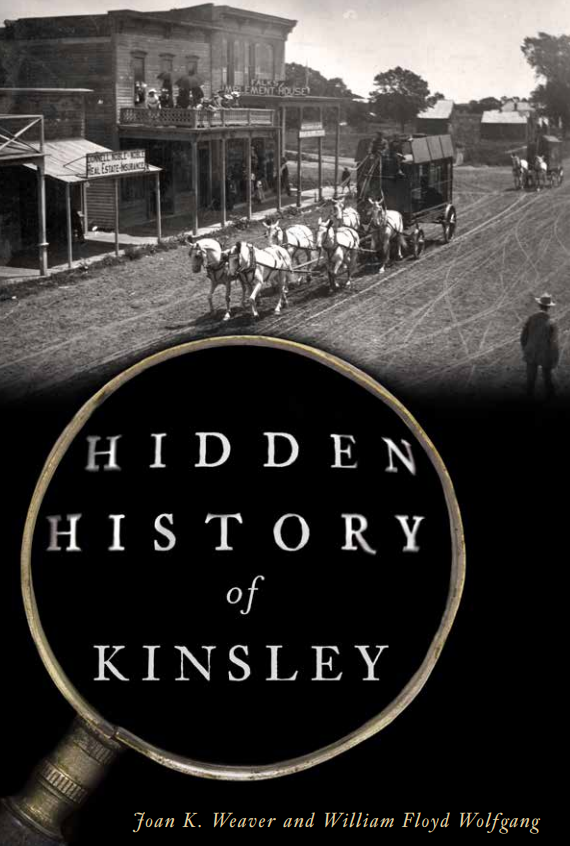
Charlie was one of many artists who made up an impressive cadre of creatives that lived in Kinsley in the early 1900s. These individuals and their contributions are featured in Hidden History of Kinsley! You can find copies of this book at the Edwards County Historical Museum and Sod House, and support the museum’s mission of preserving local history by purchasing a copy! For those reading from afar, the book is available for purchase on various other sites online.
I hope you get the opportunity to learn all about this fascinating era in history that came to a close exactly one century ago with Charlie’s passing. The work he did to unite the Kinsley, Kansas community in collective projects is inspiring. It can continue to be a blueprint for us as we think about strengthening our community ties in advance of our nation’s 250th anniversary.
Sources:
Shoup, Gail Leo. The Pasadena Community Playhouse: its origins and history from 1917 to 1942. Doctoral Dissertation, UCLA, 1968.
Wolfgang, William. The Hidden History of Kinsley, co-written with Joan Weaver, The History Press, 2025.
Wolfgang, William. “Grassroots Shakespeare: ‘I love Shakespeare, and I live here’: Amateur Shakespeare Performance in American Communities.” Shakespeare Bulletin, vol. 39 no. 3, 2021, pp. 355-373.
Wolfgang, William Floyd. Grassroots Shakespeare: amateur and community-based Shakespeare performance in the United States of America. PhD thesis, University of Warwick, 2020.


 Community Arts Uncovered
Leave a comment