

Pasadena Playhouse Founder Gilmor Brown’s earliest adventures
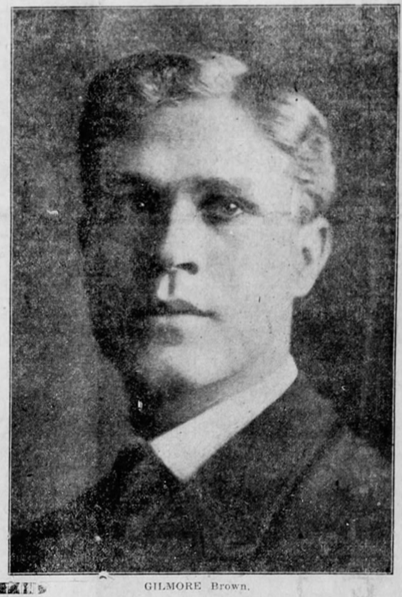
Nineteen-year-old actor George Gilmor Brown, or simply “Gilmor” as he preferred to be called professionally, prepared his belongings for the first grand adventure of his life. The blond-hair blue-eyed, perfectly groomed young man from New Salem, North Dakota had been contracted as a professional touring actor. He would be leaving Chicago shortly to perform with the Ben Greet Company. Gilmor’s contract indicated that he would perform minor supernumerary roles and occasionally a “bit part,” if available. So, it wasn’t a massive professional breakthrough, but it was certainly a solid stepping stone to the next opportunity.
Ben Greet was not the average second-rate regional performer who visited small towns to mid-sized cities, where Gilmor might have expected to land a first acting gig; on the contrary, he was a noteworthy British Shakespearean impresario who had gained considerable popularity through his educational touring initiatives. His performances, especially on college campuses, had already become an American mainstay. When he arrived in New York in 1902 to perform his critically acclaimed Everyman, he already had over one thousand open-air Shakespeare performances under his belt. By the spring of 1903, he mounted what was celebrated as the first-ever outdoor theatre performance in Manhattan with his production of As You Like It starring the renowned Edith Wynne Mathison (Dugas).
While fashionable American society had been intrigued by outdoor performances in the 1890s, such as performances at the 1893 Chicago World’s Fair, the nation had never seen anything like Ben Greet, as Don-John Dugas writes extensively in his book, Shakespeare for Everyman. Greet’s Shakespeare was fast-paced, with only moments between acts. His work included minimal to no set or scenery as Elizabethan music and costumes took center stage, banishing nineteenth-century traditions in a fresh and reinvigorating way. Furthermore, the method was already proven; Greet had been running his sylvan Shakespeare at Oxford and Cambridge for over a decade. Now, it was time for North America to enjoy the phenomenon. Since 1903, Greet returned to the University of Toronto every summer to stage Shakespeare productions. It was the first touring Shakespeare festival on the continent. The presentations also traveled to Brown, Harvard, Princeton, Wellesley, and Yale (Dugas 74).
Greet’s American ambitions fed on different cultural factors than the ones that enabled the annual performances at Oxford and Cambridge. The United States was not born with a sacred Bard as its British cousins were. After winning independence, Americans could cast the Shakespearean canon away and start fresh with a different literary legacy. But that did not happen. Instead, Shakespeare became a popular pioneer companion and a ubiquitous educational tool. Even solidly religious elements like the Chautauqua Institute, a traveling circuit for Christian morality-based edification, could not resist the morals and upright nature they located in Shakespeare.
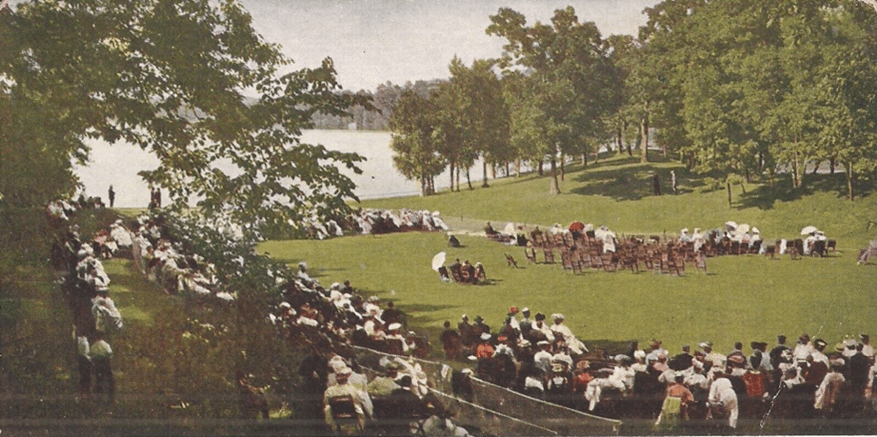
Even still, there was an opportunity for growth as this work intersected with various movements bubbling to the surface of a changing cultural ecosystem. Greet capitalized on this. The image here shows Ben Greet’s company performing at Deep Haven, Lake Minnetonka, Minnesota, during Gilmor Brown’s first season with the company.
Both serendipity and hard work led the young Gilmor Brown to his coveted place playing extras in Greet’s company. At age six, in 1892, a winding path took him and his family from his birthplace in North Dakota, to Denver, Colorado. There, he attended school. Gilmor described his experience as a “ghastly” time (Shoup 18). He dreamed of escaping into his wanderlust by becoming a railroad engineer. Yet, Gilmor would find freedom in expression, not travel. The stage intrigued him. Even minor vaudeville performances incited allure. After a captivating poster caught his eye, his life would change forever. He persuaded his parents to buy him a ticket to see this advertised performance by Minnie Maddern Fiske.
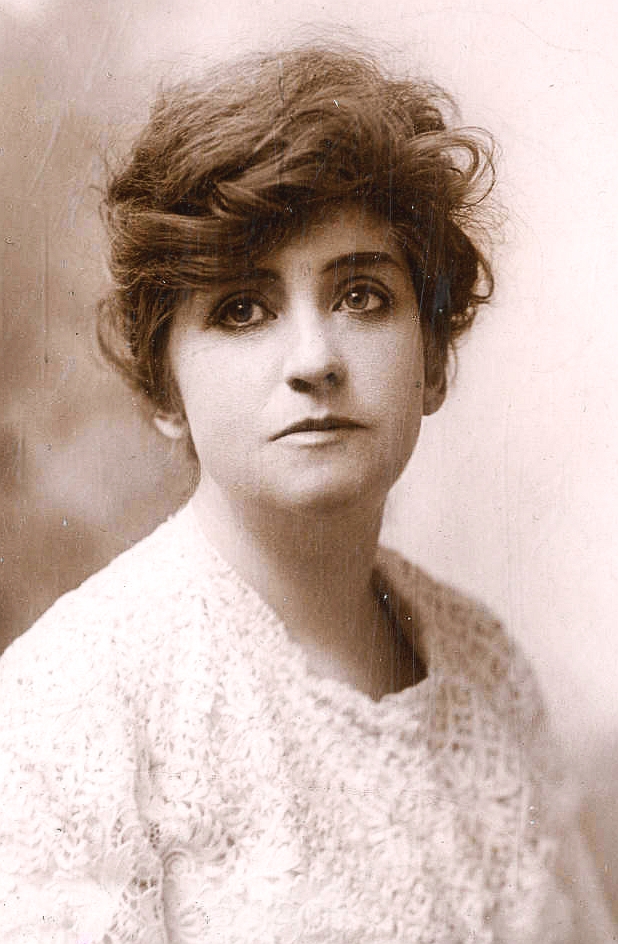
In January of 1901, the famed Mrs. Fiske (pictured here) was scheduled to play one of her most celebrated roles, the titular role in Becky Sharp (Rocky Mountain News, 7 Jan 1901). Gilmor’s parents were able to afford a seat in the top gallery. His view in the theatre did not matter; he was inspired. The young starstruck thespian threw his energy and focus into the theatre. He would never look back.
Like another teenager he had yet to meet, Charlie Edwards, the motivated Gilmor recruited neighbor children to perform in plays in a slapdash home basement theatre composed of bedsheet curtains and colorful costumes. Gilmor enjoyed placing a scheming character like Henry VIII’s Cardinal Wolsey in the heart of the drama (Shoup 19). The similarities with his Kinsley-based contemporary are uncanny, save one aspect: Gilmor’s teenage casts performed with bedsheets in a basement, while Charlie’s youth performances were in a parlor with accurately lavish costuming. Charlie sat in the front row as the most prominent stars strutted across the stage; Gilmor squinted from the upper gallery.
As Charlie did in his early youth, Gilmor took his creativity from the home to the next available space: the church. Gilmor’s mother was an avid volunteer at St. Mark’s in Denver, under the pastorate of the Revered Doctor John Houghton. Mrs. Brown secured Gilmor’s performance at the church, which caught Dr. Houghton’s eye and gave him an idea. St. Mark’s had recently acquired the use of a developing picturesque lakeside campground through wealthy patronage. The church hosted a camp for children, a sort of resort for adults, called St. Mark’s in the Mountains (The Rocky Mountain News, 10 Aug 1902). At this retreat, there was some form of an outdoor theatre where Dr. Houghton gave sixteen-year-old Gilmor free rein to produce a play. The ambitious student endeavored to write an Ancient Greek-style tragedy that would “put Aeschylus to shame.” Gilmor later admitted that “it certainly did not” achieve this objective. (Brown 162).
Nevertheless, an unforeseen opportunity awaited in the audience of this tragically amateur pseudo-Greek tragedy. A woman whose society connections brought her to the idyllic mountain camp was impressed by the level of talent it took to assemble. Her learned observations of Gilmor’s talent made it clear she was not an average auditor. This woman trained under Steele MacKaye, the renowned renaissance man of the theatre, whose botched opus magnum, the Spectatorium, led to his death in ’94. She had studied in France with the finest instructors. Her name was Florence James Adams, and she was a force of nature. After her work with MacKaye, she married Milward Adams, a self-made theatrical manager of Chicago’s auditorium theatre. Both of the Adams were present at the World’s Fair Inauguration, as Milward was the master of ceremonies. They possessed a strong influence in Chicago’s arts and cultural circles. Mrs. Adams told Gilmor’s mother that her son had a place in her studio if he wished to relocate to Chicago. Gilmor did not keep destiny waiting (Shoup, 20-21; Brown 162-163 (Stevens); The Rocky Mountain News, 10 Aug 1902; Chicago Tribune, 19 Jun 1923).
Once in Chicago, Mrs. Adams propelled Gilmor into an artistic world he had never experienced before. He attended small studio lectures with characters, like the “soul of Paris,” Gabrielle Réjane. He met with Steel MacKaye’s son, Percy, who was busy continuing his poetic vendetta against the commercial theatre (Shoup, 20-21; Brown 162-163; The Rocky Mountain News, 10 Aug 1902; Chicago Tribune, 19 Jun 1923). Furthermore, when Mrs. Adams was not occupied by her perceptive multidisciplinary lectures, she adroitly sought opportunities for her protégés, such as instructing her acting students on how to properly create acting poses based on visual arts (Chicago Tribune, 13 Mar 1903).
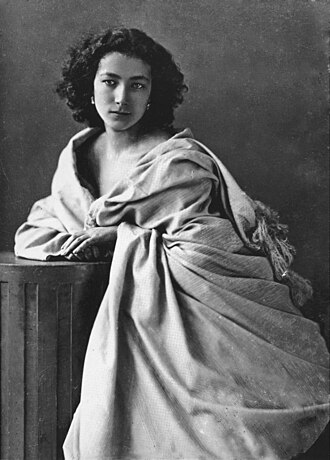
To support Gilmor, Mrs. Adams did not have to look far for further experiences. Her husband secured him a job as an usher at the Chicago Auditorium. There, the aspirant saw the New York Metropolitan Opera, two weeks of Sarah Bernhardt’s repertory (pictured here), Alla Nazimova, Nellie Melba, and Feodor Chaliapin, among innumerable others. (Shoup 21; Brown 163). Nevertheless, this ushering and stargazing job was not Florence Adams’ most munificent gift to the young actor; that was her connections. She secured him a gig with Ben Greet’s company. In 1905, Gilmor Brown’s professional acting career had begun, and the touring trail of the East Coast circuit was before him.
More to come on Gilmor’s story next week, and how he eventually walked directly into my case study in Kinsley, Kansas! His theatrical work would become incredibly consequential, but would be rarely acknowledged. More so, Gilmor’s educational efforts would go on to directly impact television and film luminaries, like Rue McClanahan, Leonard Nimoy, Dustin Hoffman, Sally Struthers, and myriad others.
Sources
Brown, George Gilmor. “A Dream on a Dime” in Ten Talents in the American Theatre edited by David H. Stevens. University of Oklahoma Press (1957).
Chicago Tribune, 17 Nov 1904
Chicago Tribune, 19 Jun 1923.
Dugas, Don-John. Shakespeare for Everyman: Ben Greet in Early Twentieth-century America. Society for Theatre Research, 2016.
Rocky Mountain News, 7 Jan 1901.
Rocky Mountain News, 10 Aug 1902.
Shoup, Gail Leo. The Pasadena Community Playhouse: its origins and history from 1917 to 1942. Doctoral Dissertation, UCLA, 1968.

 Community Arts Uncovered
Leave a comment