


I first arrived in Kinsley, Kansas in June 2019 from Merced, Califronia, drawn by a mystery in American theatre history.
My doctoral research focused on community-based Shakespeare performance, and I had just completed productions with Shakespeare in Yosemite and Merced ShakespeareFest. While digging through archival sources, I came across an obscure reference in a 1968 UCLA dissertation claiming that “Kingsley, Kansas” was once home to a remarkable Shakespeare festival.
That clue took me 1,500 miles away, straight to Kinsley’s Public Library, where I contacted director Joan Weaver for help uncovering materials about the town’s forgotten festival. What I discovered was far more than the passing reference that I originally led me to the small Western town:
It was evidence that Kinsley had been the site of a transformational movement at the intersection of small-town cultural life, civic engagement, and community theatre history.
I soon established that Kinsley was the site of a transformational movement at the intersection of American entertainment, civics, and artistic engagement. There was enough for a book on this intriguing time in America’s history! For six years, I’ve been reviewing the work of the festival’s director, Kinsley native Charles Edwards (1880-1926), and his family. My on-the-ground research in Kinsley has been invaluable. Visits to the Edwards County Historical Society, Joan Weaver’s assistance, and many others who shared remembrances from an earlier era also significantly contributed.
Since then, also, I’ve searched online for the period’s Kinsley artifacts to supplement these findings. Sometimes this quest leads to compelling discoveries for The Hidden History of Kinsley and the occasional mysterious rabbit hole. Unfortunately, many of these findings will not make it into the final text.
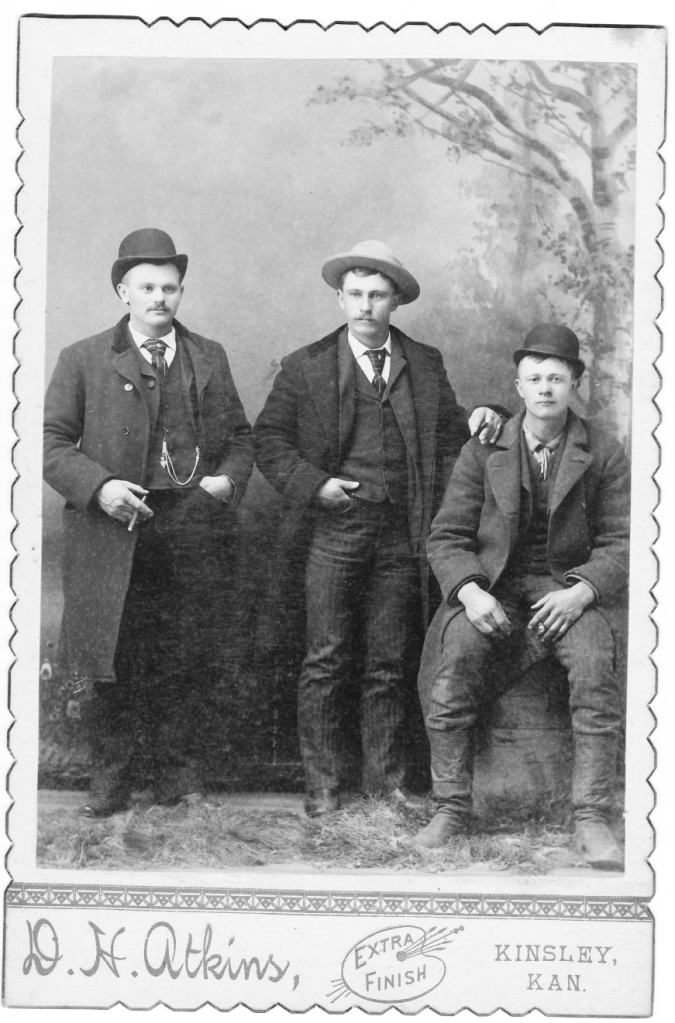
Finding a Mysterious Cabinet Photo, Circa 1890
One of these examples, which goes unused in my upcoming publications, tells the story of three previously unknown men who helped build their communities. This 135-year-old cabinet photo (a style of portrait photography popular from 1870–1910) opened the dreaded research rabbit holes.
After acquiring the original copy of this photo, I was resolved to determine who the men were; one of them looked familiar, but I wasn’t sure exactly why or how I could have recognize him. I was resolved to discover:
Who were they, and why do I recongize one of them? Why were they photographed together in Kinsley?
And how might they connect to the town’s cultural story?
While this discovery didn’t make it into my forthcoming book, it became a perfect example of how ephemera and forgotten artifacts can shine light on unexpected aspects of community theatre history.
Next week, I’ll share what I uncovered about the men in the photo and how it connects to the mysteries of Kinsley’s cultural past. This post marks the start of Ephemeral Mysteries on Community Arts Uncovered, a section where ephemera and artifacts reveal hidden histories about America’s local theatrical scene across the centuries. Find out my the discoveries next week!

 Community Arts Uncovered
Leave a reply to Perils of Research No. 2: Continuing to follow 135-Year-Old Breadcrumbs – Community Arts Uncovered Cancel reply