

Shakespearean Detective Work
How a brief reference in a doctoral dissertation tucked away in the labyrinthine stacks at the Huntington Library in San Marion, California led me to Charlie Edwards’ story, six years ago, would have been easy to forget if it had not lead me on a years-long research journey across multiple states.
At first, it was just another research rabbit hole, an inevitable distraction that is commonplace in this line of work, but, as I told myself, this story did have relevance to my research: Charlie was the one responsible along with Pasadena Community Playhouse founder Gilmor Brown for one of the earliest examples of a Shakespeare festival in the United States. Again, my thesis was on just this, Grassroots-level, community-based Shakespeare performing groups, so I reasoned that I should uncover his story, maybe I could just learn the essential points if I researched the newspapers in Kinsley, Kansas, where the festival took place.
But I was not prepared for my growing (for lack of a better word) addiction to the twists, turns, and unpredictable discoveries. The research process had grabbed hold of me, and I unlocked a passion. I would never forget Kinsley, Kansas or the fascinating history that unfolded there.
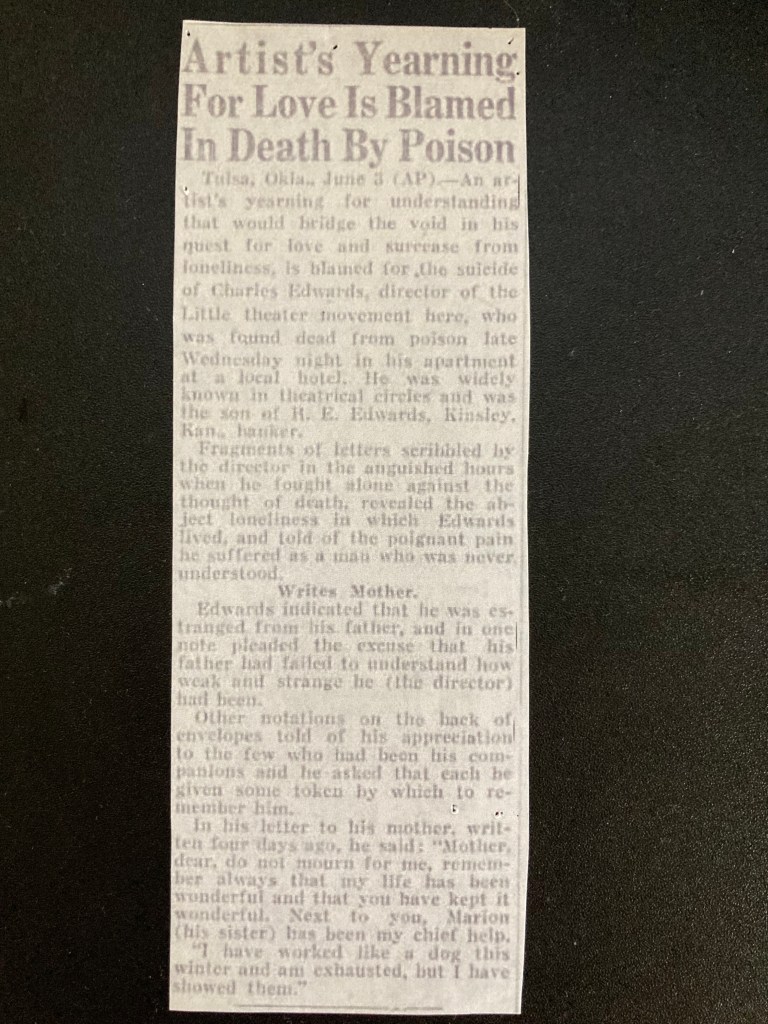
When I first truly read about the life of Charlie Edwards, the founder of Kinsley’s transformative Shakespeare festival from 1912-1916, it was a shocking death announcement. The titles of the articles alone elicited a certain pathos that made me read on and on. As an insatiable researcher, I had to learn more about this man and how he ended up the subject of the tragic headlines “Artist’s yearning for Love is Blamed in Death by Poison,” “Suicide Leaves Note Saying It was ‘So Easy,” and “Little Theatre Director Ends Life By Poison.” His death was covered in newspapers across the country, from the Kansas City Star to the New York Times.
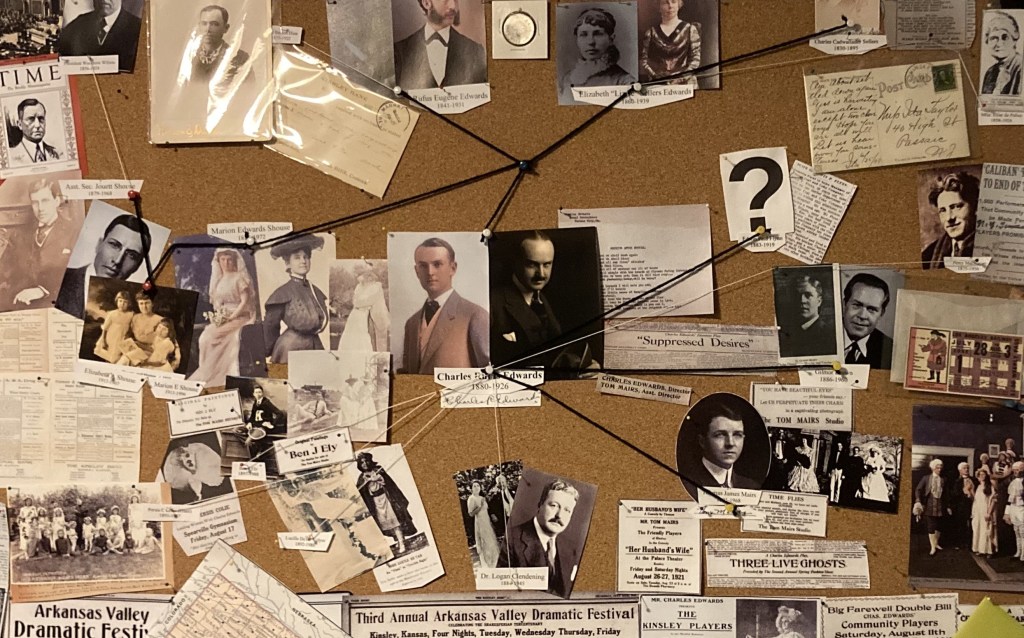
I researched more and more, newspaper after newspaper; like a detective relentlessly trying to solve a crime, I assembled a board with my growing collection of artifacts and data. Soon, I learned Charlie lived a fascinating life, spanning the Gilded Age to the Jazz Age.
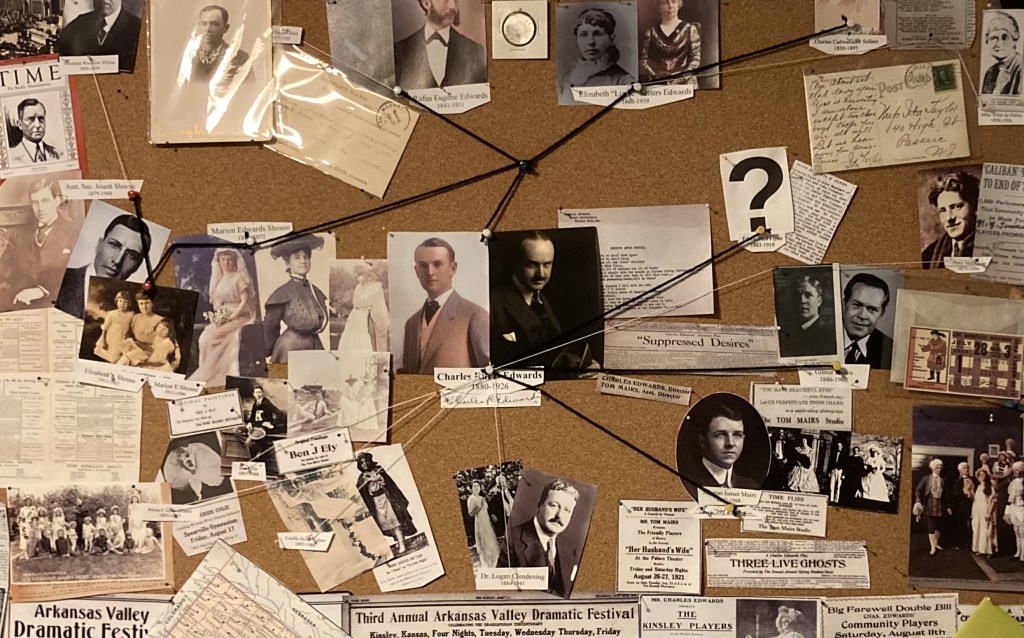
He founded a Grassroots Shakespeare festival that included up to 300 actors in the rural Western Kansas town of Kinsley. He regularly dined with members of the President of the United States’ cabinet and lingered around the periphery of the Algonquin Round Table. His father was a cattle baron, and his mother was a community arts supporter and spiritualist. His sister was a thriving Wellesley grad and wife to a United States congressman. Charlie himself was an actor, director, producer, poet, and newspaper publisher. He began his tenure at his small-town country newspaper with an astonishingly homoerotic story based on his own life experiences. With all of these intriguing facts swirling around me, I just kept digging and never looked back.
After several years, many visits to Kinsley, and days piecing together photos, yarn, and thumb tacks on a corkboard, I completed the first draft manuscript of Charlie’s story, Fairies in the Short Grass. Before it reaches publication, I need to take it through one final revision/rewrite, so in many ways, the story continues. And, I hope to share those developments here.
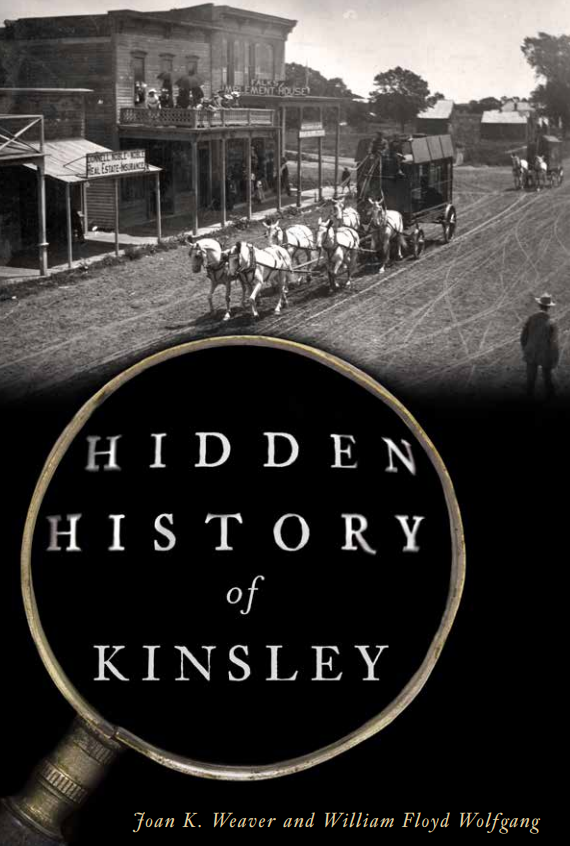
More immediately, however, I had amassed a large database of stories about artists from Charlie’s hometown of Kinsley, and I felt like these stories that I had discovered would simply fade away. So, I reached out to Joan Weaver, the director of Kinsley Public Library at the time, and asked if she’d be willing to put her thorough research on the town’s poets and other historical curiosities into conversation with mine in a book. She jumped on board, and we proposed our book Wild, Woolly and Well-Read to the History Press. They offered us a contract in their Hidden History Series, entitled the Hidden History of Kinsley, and we’re excited to share it with readers in October 2025!

 Community Arts Uncovered
Leave a comment